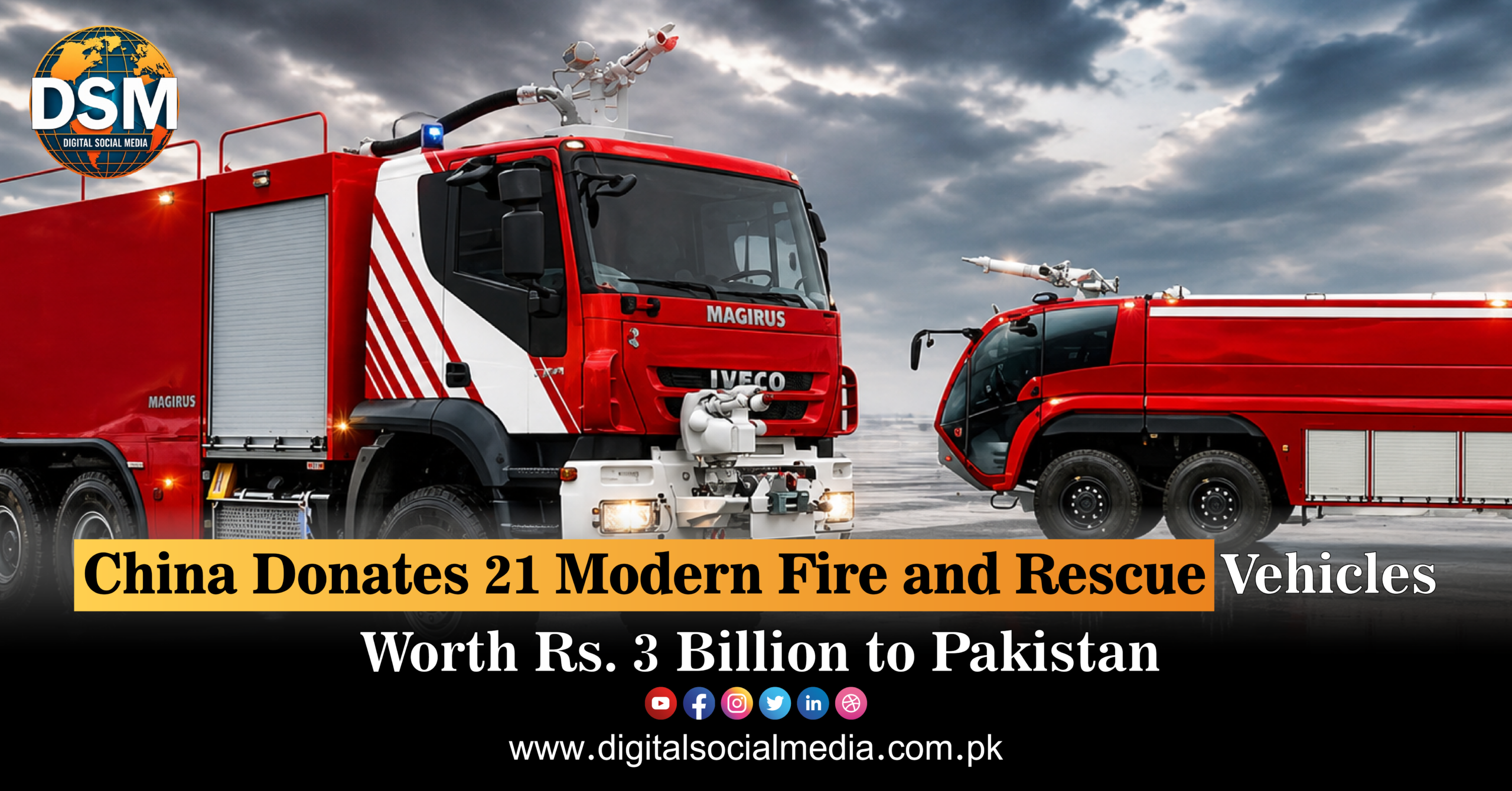
China Donates 21 Modern Fire and Rescue Vehicles Worth Rs. 3 Billion to Pakistan
China is set to strengthen Islamabad’s emergency response infrastructure by providing 21 modern fire and rescue vehicles along with advanced emergency equipment worth approximately Rs. 3 billion. The development comes at a critical time following the tragic fire incident at the Pakistan Institute of Medical Sciences (PIMS), which renewed national concern about fire safety and emergency preparedness.
The assistance is expected to provide a significant upgrade to Islamabad’s ageing firefighting and rescue infrastructure. According to reports, the existing fleet used by the Islamabad Fire Brigade has largely remained dependent on equipment procured many years ago, with the last major purchase for the Capital Development Authority’s fire department taking place in 2006.
The new Chinese assistance is therefore being seen as an important step towards modernising the capital’s capacity to respond to fires, high-rise emergencies, accidents, and other rescue situations.
Major Upgrade for Islamabad’s Fire and Rescue System
The package includes 21 modern fire and rescue vehicles as well as specialised emergency equipment. The total value of the assistance is reported to be around 72.31 million Chinese yuan, equivalent to approximately Rs. 3 billion.
One of the most significant additions is expected to be a modern snorkel fire tender designed for operations involving tall buildings.
The advanced vehicle is reportedly capable of reaching heights of approximately 88 metres, compared with the current firefighting equipment in Islamabad, which can reach around 68 metres.
This increase in operational reach could significantly improve the ability of emergency services to conduct firefighting and rescue operations in high-rise buildings.
PIMS Tragedy Raises Serious Safety Concerns
The development comes shortly after the tragic fire incident at PIMS in Islamabad, where the loss of newborn lives shocked the country and raised serious questions about fire safety arrangements and emergency preparedness.
The tragedy led to renewed attention on safety standards in hospitals and other important public buildings.
The National Assembly also expressed deep sorrow over the incident and called for accountability where negligence or safety failures were found. The tragedy highlighted the importance of effective emergency exits, firefighting systems, trained personnel, and rapid rescue capabilities.
The planned arrival of modern rescue vehicles could help Islamabad strengthen its overall preparedness for future emergencies.
Replacing an Ageing Emergency Fleet
Modern firefighting requires far more than conventional fire engines.
Today’s emergency services must be capable of responding to building fires, road accidents, structural collapses, natural disasters, industrial emergencies, and urban search-and-rescue operations.
The age of Islamabad’s existing firefighting fleet has created increasing concern about whether emergency services have access to the equipment needed for a rapidly developing capital city.
With high-rise buildings and major infrastructure continuing to expand, the need for modern rescue technology has become increasingly important.
The new Chinese package is expected to help fill some of these gaps.
High-Rise Rescue Capability to Improve
The modern snorkel fire tender could become one of the most important additions to Islamabad’s emergency infrastructure.
Its ability to reach approximately 88 metres would provide firefighters with greater access to upper floors of tall buildings.
High-rise fires present major challenges because firefighters must reach affected areas quickly while also evacuating people trapped at higher levels.
Additional reach can provide greater flexibility during rescue operations and improve the ability of emergency teams to respond effectively.
Pakistan-China Cooperation Continues
The assistance also highlights the longstanding strategic relationship between Pakistan and China.
The fire and rescue package is being provided under a Pakistan-China memorandum of understanding signed in 2024.
The cooperation demonstrates how bilateral partnerships can extend beyond infrastructure and economic projects to include public safety and emergency response.
For Pakistan, modernising emergency services is becoming increasingly important as cities expand and urban populations grow.
Access to advanced rescue technology can help authorities prepare for complex emergencies and improve public safety.
Expected Arrival in September
Reports indicate that the modern vehicles and equipment are expected to arrive in Pakistan in September.
Once deployed, the new fleet could strengthen the operational capabilities of Islamabad’s emergency services and support the CDA Fire Department in responding to a wider range of emergencies.
The equipment may also support operations involving fires, traffic accidents, building collapses, high-rise rescues, and other major incidents.
A Step Towards Stronger Emergency Preparedness
The tragic PIMS incident demonstrated the devastating consequences that can result when emergency preparedness and safety systems fail.
While modern vehicles alone cannot prevent every tragedy, advanced equipment can play an important role in improving response times and expanding rescue capabilities.
Pakistan’s growing cities require emergency services that are properly equipped, regularly trained, and prepared to respond to modern challenges.
The Chinese assistance represents an important opportunity to improve Islamabad’s firefighting and rescue infrastructure.
Conclusion
China’s provision of 21 modern fire and rescue vehicles and emergency equipment worth around Rs. 3 billion marks a major development for Islamabad’s emergency response system.
The package is expected to modernise an ageing fleet and significantly improve high-rise firefighting and rescue capabilities.
Following the heartbreaking PIMS tragedy, the need for stronger fire safety and emergency preparedness has become even more urgent.
The arrival of modern equipment is a positive step, but long-term improvements will also require stronger safety standards, trained emergency personnel, regular inspections, and effective coordination between institutions.
Together, these measures can help Pakistan build a more capable and resilient emergency response system for the future.