
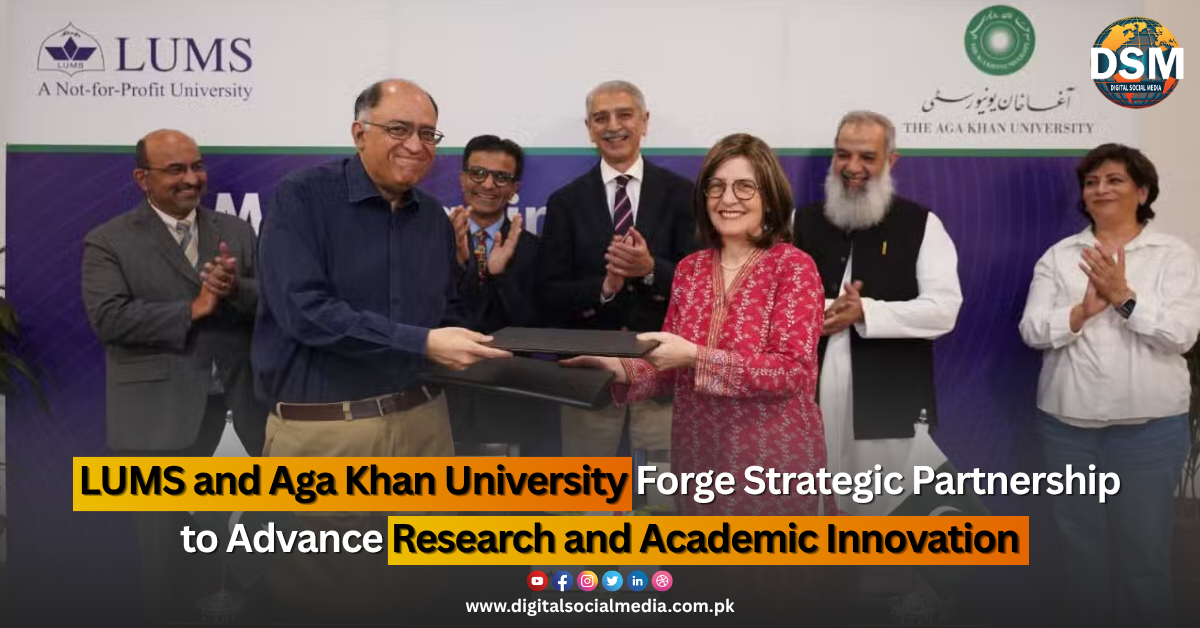
LUMS and Aga Khan University Forge Strategic Partnership to Advance Research and Academic Innovation
Pakistan’s higher education landscape has received a significant boost as LUMS (Lahore University of Management Sciences) and Aga Khan University (AKU) signed a Memorandum of Understanding (MoU) aimed at strengthening joint research, academic cooperation, and knowledge exchange initiatives.
The strategic agreement marks an important step toward expanding collaboration between two of Pakistan’s leading educational institutions. By joining forces, both universities aim to promote innovation, interdisciplinary research, academic excellence, and institutional development across multiple educational and scientific domains.
The newly signed MoU reflects a growing global trend in higher education where universities increasingly collaborate to address complex challenges through shared expertise, research partnerships, and collaborative learning models.
Academic partnerships play a critical role in modern education systems. Universities around the world are increasingly building alliances to enhance research capabilities, improve teaching methodologies, expand student opportunities, and strengthen global competitiveness.
Through this collaboration, LUMS and Aga Khan University are expected to explore opportunities for joint research projects, faculty cooperation, academic exchange programs, seminars, conferences, and collaborative educational initiatives.
Research-driven institutions often benefit significantly from strategic partnerships because collaborative environments can accelerate innovation and strengthen the impact of academic work.
Both universities have established strong reputations within Pakistan’s higher education sector. Their combined strengths in education, healthcare, research, social sciences, business studies, and innovation could create new pathways for interdisciplinary collaboration.
Joint academic initiatives frequently contribute to stronger research outputs by enabling scholars, researchers, and faculty members to combine expertise from multiple fields.
In today’s knowledge-driven economy, universities are increasingly expected to play active roles in solving real-world challenges through research, policy engagement, and innovation. Collaborative frameworks allow institutions to pool intellectual resources and develop broader solutions to emerging national and global issues.
The MoU between LUMS and Aga Khan University may also contribute positively to Pakistan’s research ecosystem by encouraging stronger institutional connectivity and knowledge-sharing practices.
Educational experts emphasize that collaborative research partnerships can support advancements in areas such as public policy, technology, healthcare, economics, sustainability, business innovation, and social development.
Academic collaboration is not limited to research alone. Such agreements often create valuable opportunities for students and faculty members through workshops, mentorship programs, skill-building initiatives, and international academic exposure.
Student engagement remains an important component of modern university partnerships. Access to interdisciplinary learning experiences and collaborative academic environments can strengthen critical thinking, innovation capacity, and professional readiness.
The agreement highlights the growing importance of institutional partnerships in building competitive higher education systems capable of meeting evolving societal and industry needs.
Pakistan’s education sector continues pursuing greater emphasis on research quality, academic modernization, and international collaboration. Partnerships between leading universities can play an important role in supporting these broader national objectives.
Observers believe initiatives of this nature could encourage additional collaboration among academic institutions across Pakistan, helping strengthen the country’s overall educational and research capabilities.
Higher education institutions increasingly face expectations to generate meaningful societal impact through knowledge creation and evidence-based problem solving. Strategic academic alliances provide one pathway toward achieving these goals more effectively.
Research collaboration can also enhance funding opportunities, increase publication quality, and improve access to specialized expertise and institutional resources.
The partnership between LUMS and Aga Khan University arrives at a time when innovation, digital transformation, and interdisciplinary problem-solving continue shaping the future of education globally.
Supporters of the initiative believe that stronger cooperation between prominent institutions can help create lasting value for researchers, educators, students, policymakers, and broader society.
As Pakistan seeks to strengthen its higher education and research environment, collaborations between leading universities remain increasingly important for driving academic excellence and knowledge advancement.
The MoU signed by LUMS and Aga Khan University therefore represents more than an institutional agreement—it reflects a shared commitment toward research leadership, academic innovation, and collaborative educational progress.
With growing emphasis on partnerships and knowledge exchange, the collaboration may help shape new opportunities for academic growth and research excellence within Pakistan’s evolving education landscape.