
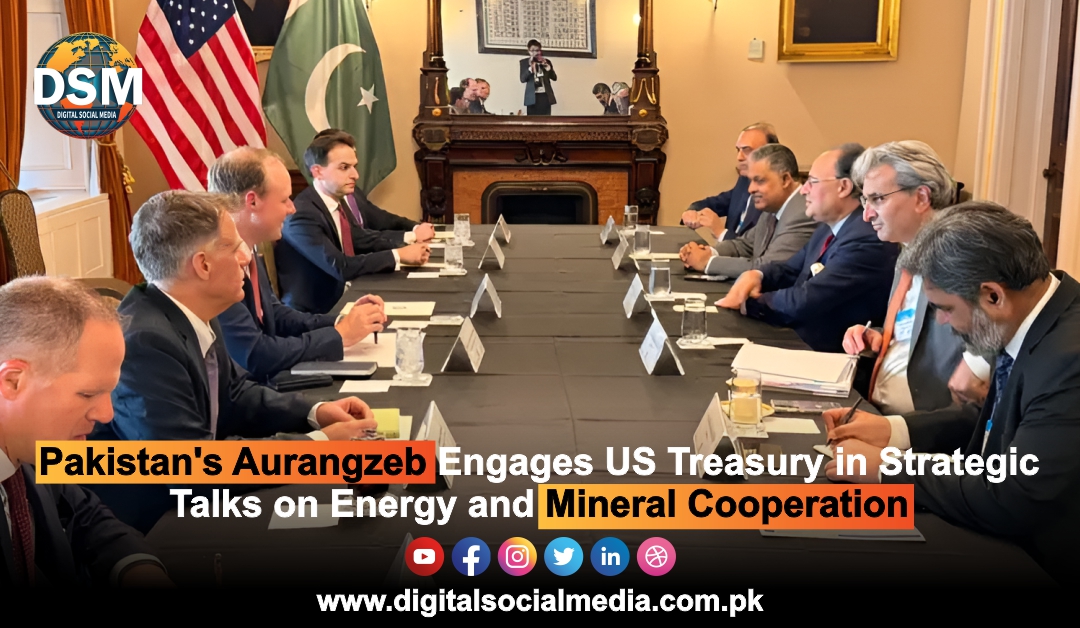
Pakistan’s Aurangzeb Engages US Treasury in Strategic Talks on Energy and Mineral Cooperation
Pakistan’s Finance Minister Muhammad Aurangzeb recently held a “productive” meeting with officials from the United States Department of the Treasury, signaling renewed efforts to strengthen economic ties between the two countries. The discussions focused on exploring new avenues for cooperation in the energy and mineral sectors—areas considered critical for Pakistan’s long-term economic stability.
The meeting comes at a time when Pakistan is actively seeking foreign investment and technical partnerships to address its economic challenges. With rising energy demands and untapped mineral resources, the country is positioning itself as a potential hub for strategic collaboration. The dialogue with US Treasury officials reflects Islamabad’s intent to diversify its economic partnerships and attract global stakeholders.
During the talks, both sides emphasized the importance of sustainable energy development. Pakistan is currently facing energy shortages and high import costs, making it essential to explore alternative energy solutions. Collaboration with US institutions could open doors for investment in renewable energy projects, including solar, wind, and hydropower initiatives. Such partnerships could help Pakistan reduce its reliance on imported fuels and stabilize its energy sector.
In addition to energy, the discussion also highlighted the vast potential of Pakistan’s mineral resources. The country is rich in critical minerals, including copper, gold, and rare earth elements, which are increasingly important in global supply chains. By engaging with US stakeholders, Pakistan aims to develop these resources responsibly while ensuring transparency and economic benefits.
Officials from the United States Department of the Treasury reportedly acknowledged Pakistan’s reform efforts and expressed interest in supporting initiatives that promote economic resilience. The meeting also touched on broader financial cooperation, including improving regulatory frameworks and enhancing investor confidence.
The engagement is part of Pakistan’s broader strategy to strengthen ties with key international partners. The government has been working on economic reforms aimed at stabilizing the currency, reducing fiscal deficits, and improving the business environment. Partnerships with global institutions are seen as vital to achieving these goals.
Experts believe that cooperation in the mineral sector could be particularly transformative. With increasing global demand for critical minerals used in technology and clean energy, Pakistan has an opportunity to become a significant player in the international market. However, this will require investment in infrastructure, technology, and governance—areas where collaboration with US partners could prove beneficial.
The meeting also underscores the importance of diplomatic engagement in economic policymaking. By maintaining open channels of communication with major economies, Pakistan can better navigate global financial challenges and identify opportunities for growth.
Finance Minister Muhammad Aurangzeb described the discussions as constructive and forward-looking, emphasizing the shared commitment to exploring mutually beneficial initiatives. He reiterated Pakistan’s willingness to work with international partners to unlock its economic potential.
From a broader perspective, the talks reflect a growing recognition of the interconnected nature of global economies. Energy security, resource management, and financial stability are challenges that require collaborative solutions. By engaging with the United States, Pakistan is taking steps toward integrating more deeply into the global economic system.
In conclusion, the meeting between Pakistan and US Treasury officials marks a positive development in bilateral relations. With a focus on energy and mineral cooperation, both sides have identified key areas for collaboration that could drive economic growth and sustainability. As discussions progress, the outcomes of this engagement could play a crucial role in shaping Pakistan’s economic future.