
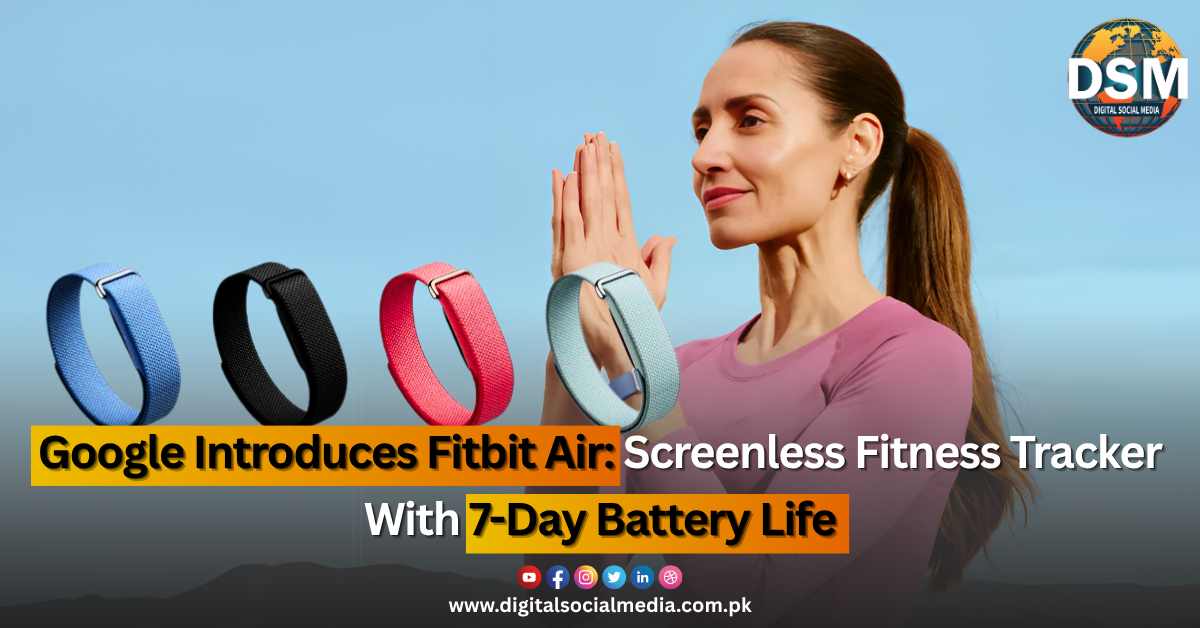
Google Introduces Fitbit Air: Screenless Fitness Tracker With 7-Day Battery Life
Google
has officially introduced the new Fitbit Air, a minimalist screenless fitness wearable designed to deliver extended battery life, lightweight comfort, and simplified health tracking. The launch signals a fresh direction in wearable technology, focusing on distraction-free fitness monitoring while prioritizing convenience and long-lasting performance.
Unlike traditional smartwatches and fitness bands that rely heavily on interactive displays, Fitbit Air removes the screen entirely. The device instead focuses on passive health tracking, seamless smartphone integration, and smart notifications delivered through companion applications and connected devices.
One of the standout features of Fitbit Air is its impressive battery performance. Google claims the wearable can last up to an entire week on a single charge, addressing one of the most common frustrations among smartwatch users—frequent charging. The extended battery life is expected to appeal to users seeking uninterrupted fitness and sleep tracking without the inconvenience of daily charging cycles.
The minimalist design philosophy behind Fitbit Air reflects a growing trend in consumer technology where simplicity and comfort are becoming increasingly important. Many users prefer lightweight wearables that provide health insights without the distractions associated with large screens and constant notifications.
Fitbit Air is designed to monitor essential health and fitness metrics, including step count, heart rate, sleep quality, calorie burn, and activity levels. Advanced sensors integrated into the wearable aim to deliver accurate tracking while maintaining a compact and lightweight form factor.
Sleep tracking remains one of the key features expected to attract consumers. Since the device is optimized for long battery life and lightweight wearability, users can comfortably wear it overnight for continuous sleep analysis. This aligns with the increasing demand for wellness-focused devices that help users better understand recovery, stress, and daily activity patterns.
The wearable is also expected to integrate deeply with Google’s health ecosystem, allowing users to access detailed fitness reports and insights through connected mobile applications. By leveraging cloud-based data analysis and AI-driven recommendations, Fitbit Air aims to provide meaningful health information without requiring constant interaction with the device itself.
Industry analysts believe the launch represents an interesting shift in the wearable technology market. While many manufacturers continue adding larger displays and smartwatch features, Google appears to be targeting users who prioritize simplicity, battery efficiency, and wellness tracking over multimedia functionality.
The introduction of a screenless wearable could also help reduce digital fatigue. With consumers already spending significant time on smartphones and other screens, products like Fitbit Air may appeal to individuals looking for healthier and less distracting technology experiences.
Another major advantage of the screenless approach is improved durability and reduced power consumption. Without a display consuming battery resources, the device can maintain longer operational life while potentially becoming more resistant to physical wear and environmental factors.
Fitness wearables have become increasingly competitive in recent years, with brands focusing heavily on health monitoring, AI integration, and lifestyle convenience. Google’s Fitbit Air enters the market as a unique alternative to traditional smartwatches, offering a more streamlined experience centered around passive wellness tracking.
Experts suggest that the success of Fitbit Air may depend on how effectively users adapt to a screen-free wearable experience. While some consumers value visual interaction and on-device controls, others may appreciate the simplicity and reduced distractions offered by the new design.
The launch also highlights Google’s broader strategy in health-focused technology. Wearables are playing an increasingly important role in preventive healthcare, fitness management, and digital wellness, making this segment a key area of innovation for major technology companies.
As consumer preferences continue evolving, Fitbit Air represents an experiment in redefining what a fitness wearable can be. Rather than competing directly with feature-heavy smartwatches, the device focuses on comfort, battery longevity, and essential health tracking.
With its minimalist design and week-long battery performance, Fitbit Air may help shape a new category of wearables designed for users who want health insights without the complexity of traditional smart devices.