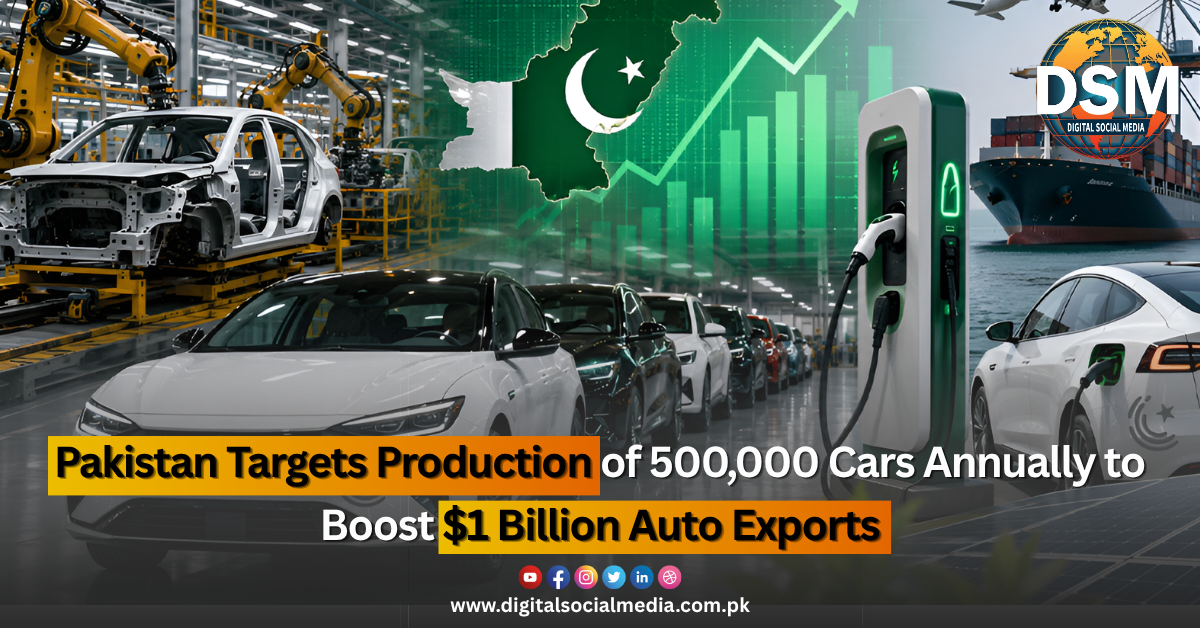
Pakistan Targets Production of 500,000 Cars Annually to Boost $1 Billion Auto Exports
The government of Pakistan is aiming to significantly expand the country’s automotive sector by targeting the local production of 500,000 vehicles annually while generating nearly $1 billion in automobile exports. The ambitious plan reflects Pakistan’s broader strategy to strengthen industrial growth, increase exports, and position the country as a competitive player in the regional automotive market.
Officials believe the initiative could transform Pakistan’s automobile industry by increasing manufacturing capacity, attracting foreign investment, and creating thousands of employment opportunities across related sectors. The strategy is expected to focus on improving localization, encouraging technology transfer, and supporting long-term industrial development.
Pakistan’s auto sector has experienced steady growth over the past decade, driven by rising consumer demand, infrastructure development, and increased participation from international automobile manufacturers. However, policymakers now aim to move beyond domestic consumption and establish Pakistan as an export-oriented automotive production hub.
The target of producing 500,000 cars annually represents a significant increase compared to current production levels. Achieving this goal would require substantial investment in manufacturing infrastructure, supply chains, workforce training, and component localization.
Industry experts believe localization will play a key role in reducing production costs and strengthening export competitiveness. Increasing the use of locally manufactured parts can reduce dependence on imports, stabilize pricing, and support domestic engineering industries.
The government’s export target of $1 billion highlights growing confidence in the potential of Pakistan’s automotive sector. Export-oriented manufacturing could help improve the country’s trade balance while generating valuable foreign exchange earnings.
Analysts note that global automobile markets are becoming increasingly competitive, with countries across Asia investing heavily in automotive manufacturing and export strategies. Pakistan’s challenge will be to improve quality standards, production efficiency, and regulatory frameworks to compete effectively with established manufacturing hubs.
The success of the initiative may also depend on policy continuity and investor confidence. Long-term industrial growth typically requires stable economic policies, supportive taxation structures, and predictable regulatory environments that encourage both local and international investment.
Several international automobile companies have already expanded operations in Pakistan in recent years, introducing new vehicle models and investing in assembly plants. Government officials hope that continued incentives and industrial support will encourage further expansion and increase production capacity.
The plan could also benefit small and medium-sized enterprises connected to the automotive supply chain. Local vendors producing auto parts, electronics, tires, batteries, and engineering components may experience increased demand as vehicle manufacturing scales up.
Employment generation is another major expected outcome of the strategy. The automotive industry supports a wide range of jobs, including manufacturing, engineering, logistics, sales, and maintenance services. Expanding production capacity could therefore contribute positively to Pakistan’s broader economic development goals.
Technological modernization is also expected to become a central focus. Global automotive trends are rapidly shifting toward electric vehicles, fuel efficiency, and smart manufacturing systems. Pakistan’s industry may need to adapt to these evolving technologies to remain globally competitive in the long term.
Infrastructure improvements, including transportation networks and industrial zones, will likely be important in supporting large-scale automotive production and export operations. Efficient logistics systems are critical for reducing production costs and ensuring timely exports to international markets.
Environmental considerations may also shape future automotive policies. As the global industry transitions toward greener technologies, Pakistan may eventually need to encourage hybrid and electric vehicle manufacturing to align with international market trends and sustainability goals.
Economic experts suggest that if implemented successfully, the strategy could contribute significantly to industrial diversification and export growth. Reducing reliance on traditional export sectors while strengthening manufacturing capabilities remains an important objective for Pakistan’s economic planners.
The government’s vision for producing 500,000 vehicles annually signals a strong commitment to industrial expansion and export development. While challenges related to infrastructure, investment, and competitiveness remain, the initiative represents a major step toward strengthening Pakistan’s position in the regional automotive industry.
As the strategy moves forward, industry stakeholders, investors, and consumers will closely monitor how effectively the country can transform its automotive ambitions into long-term economic growth and international competitiveness.