
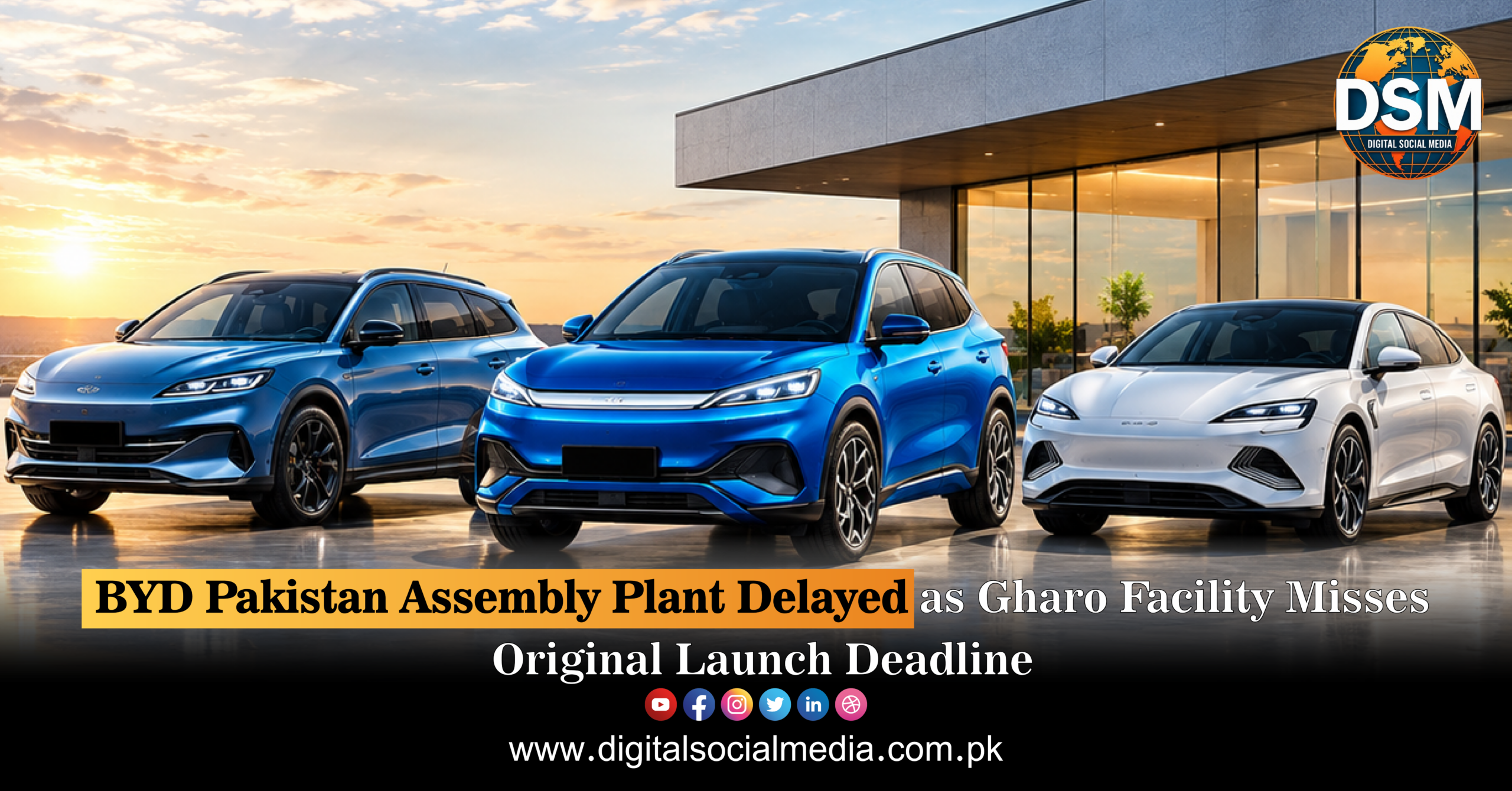
BYD Pakistan Assembly Plant Delayed as Gharo Facility Misses Original Launch Deadline
Chinese electric vehicle giant BYD’s planned assembly plant in Pakistan has missed its original operational deadline, delaying the start of local vehicle production at the company’s facility in Gharo, Sindh. The $150 million project, developed in partnership with Mega Motor Company (MMC), was initially expected to become operational during the first half of fiscal year 2025-26. The latest update indicates that the plant is now expected to come online during the second half of 2026.
The delay comes at an important time for Pakistan’s emerging electric vehicle market, where demand for new energy vehicles is growing and several international manufacturers are exploring opportunities in the country. BYD’s local assembly project is being closely watched because it could play a significant role in accelerating EV adoption, increasing localization, creating employment opportunities, and developing Pakistan’s automotive manufacturing capabilities.
BYD Assembly Plant Misses Original Deadline
The BYD assembly facility in Gharo, Sindh, was originally targeted to begin operations in the first half of FY2025-26. However, according to recent updates from Hub Power Company (HUBCO), the project is now expected to become operational in the second half of 2026.
The facility is being developed by Mega Motor Company, in which HUBCO holds a 50 percent stake, in partnership with BYD Auto Industry Company. The project represents a major investment in Pakistan’s electric vehicle sector and is expected to support local assembly of BYD new energy vehicles.
The exact reasons for the latest delay have not been publicly explained by Mega Motor Company. The company did not respond to inquiries seeking details about the revised timeline, localization plans, and other aspects of the project.
$150 Million Investment in Pakistan’s EV Industry
The BYD assembly project represents an estimated investment of $150 million, including approximately $90 million in project financing. The plant is planned with an initial production capacity of around 25,000 vehicles annually, with the possibility of scaling production to 50,000 units as market demand develops.
The investment is significant for Pakistan’s automotive industry because the country has historically depended heavily on imported vehicles and established conventional vehicle manufacturers. Local assembly of electric vehicles could help introduce new technology into the domestic market while encouraging the development of local suppliers and technical expertise.
The facility is specifically designed as a new energy vehicle assembly plant. BYD and its local partner have previously indicated that equipment installation, commissioning, validation, and production trials are important steps before commercial manufacturing can begin.
BYD’s Growing Presence in Pakistan
BYD officially entered Pakistan’s passenger vehicle market through its partnership with Mega Motor Company. The company initially began selling completely built-up vehicles imported into the country before moving toward local assembly.
Its presence in Pakistan has expanded through models such as the BYD Atto 3, BYD Seal, and BYD Shark. The company has also established experience centers and dealerships in major cities as it builds its local customer network.
The transition from importing completely built-up vehicles to local assembly represents an important stage in BYD’s Pakistan strategy. Local production could eventually help the company improve supply consistency and reduce some costs associated with importing fully built vehicles.
What Local Assembly Could Mean for EV Prices
One of the biggest questions surrounding the BYD assembly plant is whether local production will eventually make electric vehicles more accessible to Pakistani consumers.
Imported electric vehicles can face significant costs related to shipping, duties, taxes, and other import-related expenses. Local assembly could potentially reduce some of these pressures, although the final prices of locally assembled vehicles will depend on taxation policies, localization levels, production costs, currency conditions, and the prices of imported components.
The plant’s initial focus is expected to be on assembly using imported vehicle kits, with localization potentially increasing over time. Developing local suppliers and increasing domestic content could become an important part of Pakistan’s long-term EV manufacturing strategy.
Potential Impact on Pakistan’s Automotive Industry
The BYD project could have implications beyond the company itself. A successful local EV assembly operation could encourage investment in electric mobility, battery technology, charging infrastructure, automotive components, and technical training.
The Pakistani government has expressed support for BYD’s investment and localization plans. In June 2026, Finance Minister Muhammad Aurangzeb met representatives from BYD and Mega Motor Company and highlighted the potential contribution of the partnership to technology transfer, industrial development, job creation, and export growth.
BYD has also discussed plans to expand its product portfolio, accelerate localization, introduce advanced charging technologies, and train Pakistani engineers and technicians. The company has outlined a long-term vision of potentially positioning Pakistan as a regional hub for electric vehicle manufacturing and exports.
EV Charging Infrastructure Expanding
The development of the BYD assembly plant is taking place alongside efforts to improve Pakistan’s EV charging infrastructure. HUBCO’s green energy subsidiary has been expanding fast-charging facilities, including stations along important road corridors.
A wider charging network will be essential if electric vehicle adoption is to increase significantly in Pakistan. Consumers need reliable access to charging facilities for both urban and long-distance travel, particularly as more electric and plug-in hybrid vehicles enter the market.
The combination of local EV assembly and improved charging infrastructure could therefore help establish a stronger foundation for Pakistan’s electric mobility ecosystem.
What Happens Next?
Despite missing its original deadline, the BYD assembly project remains strategically important for Pakistan’s automotive and electric vehicle industries. The latest target points toward operations beginning in the second half of 2026, although the precise launch date remains subject to the completion of equipment installation, commissioning, testing, and other production requirements.
Once operational, the Gharo plant is expected to have an initial annual production capacity of approximately 25,000 vehicles. The capacity could eventually increase to 50,000 units, depending on demand and future expansion plans.
For Pakistan, the project could become an important milestone in the transition from conventional automobiles toward electric and new energy vehicles. For BYD, local assembly could strengthen its position in a developing market with significant long-term potential.
The missed deadline is therefore a setback in the project’s original timeline, but it does not necessarily change the broader significance of BYD’s investment. If the plant becomes operational as currently expected, it could mark a new phase for electric vehicle manufacturing in Pakistan and create opportunities for greater localization, technology transfer, employment, and future exports.